
Ten Questions to Turn Into Clauses Before a Home Fragrance Contract
The questions that matter before a home fragrance contract are not the ones asked on a factory tour; they are the ones that end up in the agreement. If a subject is worth raising, it is worth writing into the document: what happens if the reference sample drifts, who owns the mould, which laboratory releases the reports, and what the exit looks like. The ten questions below are grouped by the clause they belong to, so each answer lands somewhere it can actually be relied on later.
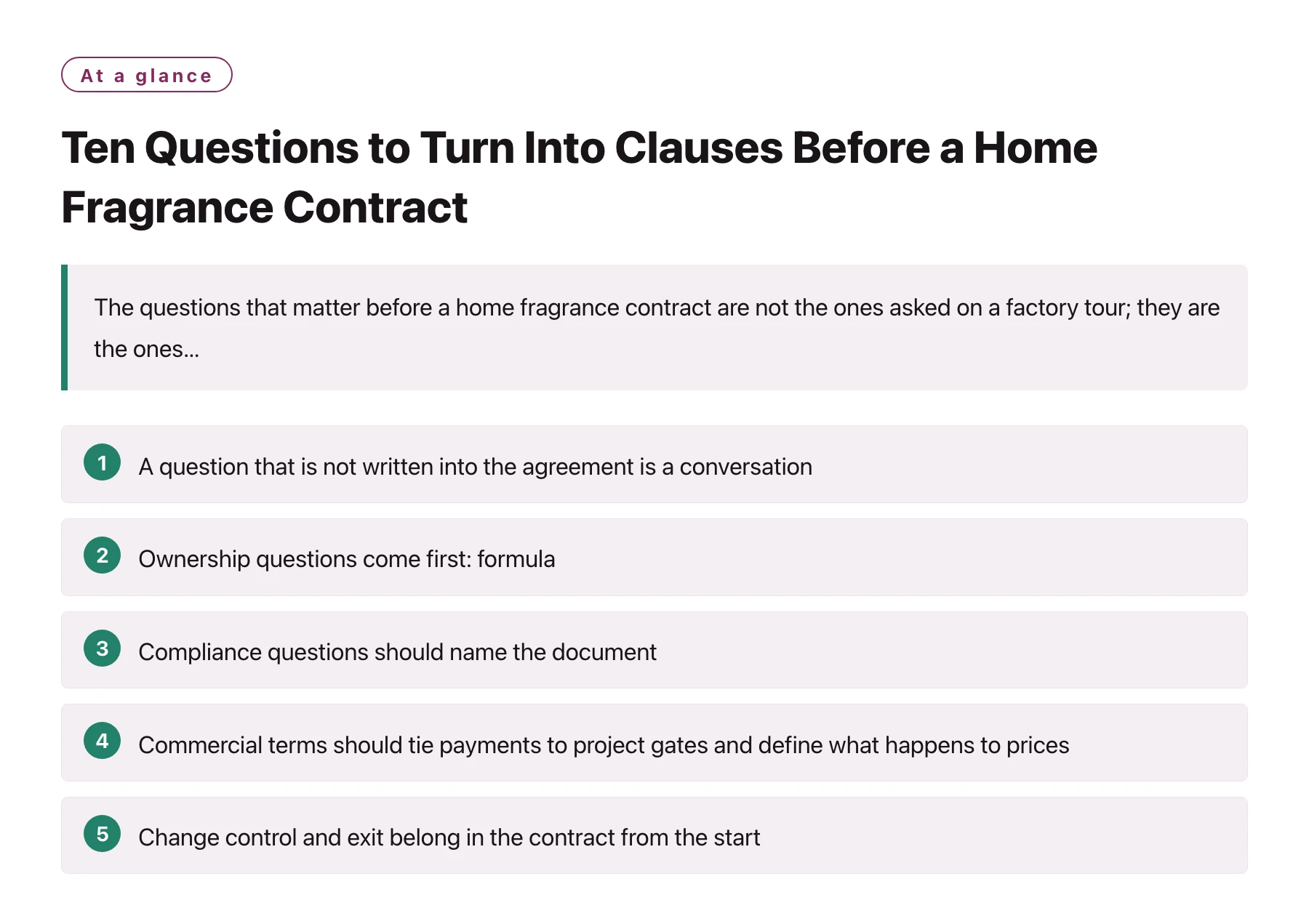
Key takeawaysA question that is not written into the agreement is a conversation, and conversations are difficult to enforce six months later. · Ownership questions come first: formula, artwork and any tooling should each have a named owner and a stated consequence. · Compliance questions should name the document, the issuer and who holds it, rather than describing an intention to comply. · Commercial terms should tie payments to project gates and define what happens to prices, minimums and specifications on a reorder. · Change control and exit belong in the contract from the start, because both are cheap to write before the first order and expensive to negotiate after it.
Buyers usually arrive at the contract stage with a good understanding of the product and a thin understanding of the document. The specification has been argued over for weeks; the clauses that decide what happens when something goes wrong have been skimmed in an afternoon.
That imbalance is fixable in about an hour. Group the questions by clause, write the answer you want, and negotiate the wording while both sides still have something to gain from agreeing.
Ownership and access
1. Who owns the fragrance formula, and what exactly does the brand receive? The answer should distinguish ownership from access. In a library-led arrangement the maker typically owns the formula and the brand has the right to be supplied; in a developed arrangement the brand usually owns it. Either is workable, but the difference decides whether a second supplier can ever quote the same product, and whether the formula can be registered or protected in the brand's name. Trade-secret protection depends on written terms and controlled disclosure rather than on registration, so what is written is what exists [1].
2. Who owns the tooling, and what happens to it if the relationship ends? If the brand funds a mould, the agreement should say so and should describe where the tool is kept, who may use it, and how it moves if the brand transfers production. A tool with no stated owner is a hostage with a production schedule attached.
3. Who owns the artwork, dielines and technical files? Labels, cartons and decoration proofs accumulate value over a programme, and the brand should be able to collect them in a usable format. This is close to the discipline behind the checks that matter before signing a contract: keep asking what you would need if you had to start again elsewhere.
A useful sanity check on all three questions is whether the supplier can answer them without consulting a lawyer. Ownership terms that nobody in the commercial conversation understands tend to be the ones that surprise people later. Manufacturers that publish a clear account of what they do — Visit site shows one version of this — are generally easier to hold to a scope, because the boundary between their work and someone else's is already stated.
Compliance and evidence
4. Which fragrance material statement covers our products, and who issues it? Fragrance materials are restricted according to the product category they are used in, and the published standards library is the reference most suppliers work from [2]. The clause should name the document, not the intention: the category, the issuer and the point at which it is provided.
5. Which packaging obligations apply, and who is responsible for meeting them? In markets where packaging rules are tightening around reuse, refill and recyclability, obligations can fall on whoever places the goods on the market rather than on the factory [3]. The contract should state who prepares the packaging information and what happens if the rules change during the programme.
6. Which tests are included, which laboratory runs them, and to whom are the reports released? A test report is only reusable if the buyer can point to it directly. Where the report is issued to the supplier's account and shared informally, that restriction should be known before the order rather than after the market asks for evidence. Independent laboratories publish the services they provide, which makes the named provider easy to check [4].
The pattern across these three is that compliance clauses should describe documents and dates. A clause that says the supplier will comply with applicable regulations has told you nothing you can act on when a retailer asks a specific question.
Commercial terms
7. What exactly does the price cover, and how long does it hold? A price without a specification is not a commitment, so the clause should tie the price to the released specification, the fill weight, the vessel and the Incoterm. Any indexation or validity period should be written next to it rather than assumed.
8. How do payments map onto project gates? The schedule should follow sample approval, first-article sign-off and shipping documents rather than the calendar alone. A schedule that puts most of the value in before the first sample gives the buyer very little leverage if the sample is wrong.
9. What are the minimum order quantities for the first order and for a reorder? These are often different numbers, and the reorder minimum is the one that matters, because it decides whether the product can be kept in the range. Ask whether the minimum applies per scent, per format or per shipment, and get the answer in writing.
10. What happens if the specification has to change after the first order? Material substitutions, component changes and reformulations all have knock-on effects on testing and artwork. The clause should require notification and re-approval when a change touches the reference, rather than permitting a supplier to substitute quietly and disclose later.
Questions seven to nine are the ones a contract manufacturer for perfume brands hears constantly, so a clear answer arrives quickly and a vague one is informative. The framing matters less than the specificity: most suppliers are comfortable committing to terms once the scope is defined, and uncomfortable committing to terms that are still open. That is another argument for settling the product before the paperwork.
Continuity, change control and exit
The clauses that decide how a relationship feels later are the ones written when it feels good. Two of them are worth insisting on. The first is a change-control clause that requires notice when anything touching the reference changes, with a named contact and a stated response time. The second is a transition clause describing what the supplier will hand over if the brand moves production: specification, artwork files, tooling details and retained samples.
Neither clause is adversarial, and both are common in manufacturing agreements across industries. What makes them valuable in a first order is that they are cheap now. A buyer who asks for a transition clause is not planning to leave; they are making sure the relationship does not become the only reason the product exists.
Finally, keep the agreement and the specification in one place and keep them versioned. Half of the disputes that reach a lawyer are arguments about which document was current, and the fix is a file-naming convention rather than a clause.
If ten questions feels like a lot to raise in one meeting, send them in writing and ask for written answers. The quality of the written reply is itself a piece of evidence about how the relationship will run.
Sources
- WIPO — World Intellectual Property Organization —— The UN agency for intellectual property; resources on industrial design and patent protection relevant to product and packaging design.
- IFRA Standards Library (International Fragrance Association) —— The IFRA Standards Library lists the restrictions the fragrance industry applies to individual fragrance ingredients, based on safety assessments; it is the reference point for compliant fragrance formulation.
- European Commission: Packaging Waste and the PPWR —— EU rules on packaging and packaging waste, including the Packaging and Packaging Waste Regulation requirements on recyclability and design.
- SGS: Cosmetics, Personal Care & Household Testing —— Testing, inspection and certification services for cosmetics and personal care, including microbiological, stability and safety testing aligned with cosmetics GMP.
Frequently asked questions
Should the fragrance formula be owned by the brand or the factory?
Both arrangements are normal. Ownership usually sits with the party that paid for the development, while library scents typically stay with the manufacturer. What matters is that the agreement says which model applies and what access the brand has.
What is a reasonable payment schedule for a first home fragrance order?
One tied to project gates: a deposit against the order, a payment against sample or first-article approval, and the balance against shipping documents. Schedules tied only to elapsed time shift risk onto the buyer.
Do I need a transition clause if I plan to stay with the supplier?
Yes, and it is easier to agree while the relationship is new and positive. The clause simply describes what documentation and tooling the brand receives if production moves, which also improves continuity if the supplier changes ownership.
How specific should the compliance clause be?
Specific enough to name documents: the fragrance category statement and its issuer, the packaging information, and the tests included with the laboratory that runs them. General statements of compliance cannot be acted on when a retailer asks a question.
What is the most common omission in a first contract?
Change control. Buyers usually secure price and delivery, and forget to require notification when a material, component or process touching the approved reference changes, which is precisely when a reorder stops matching the original.